
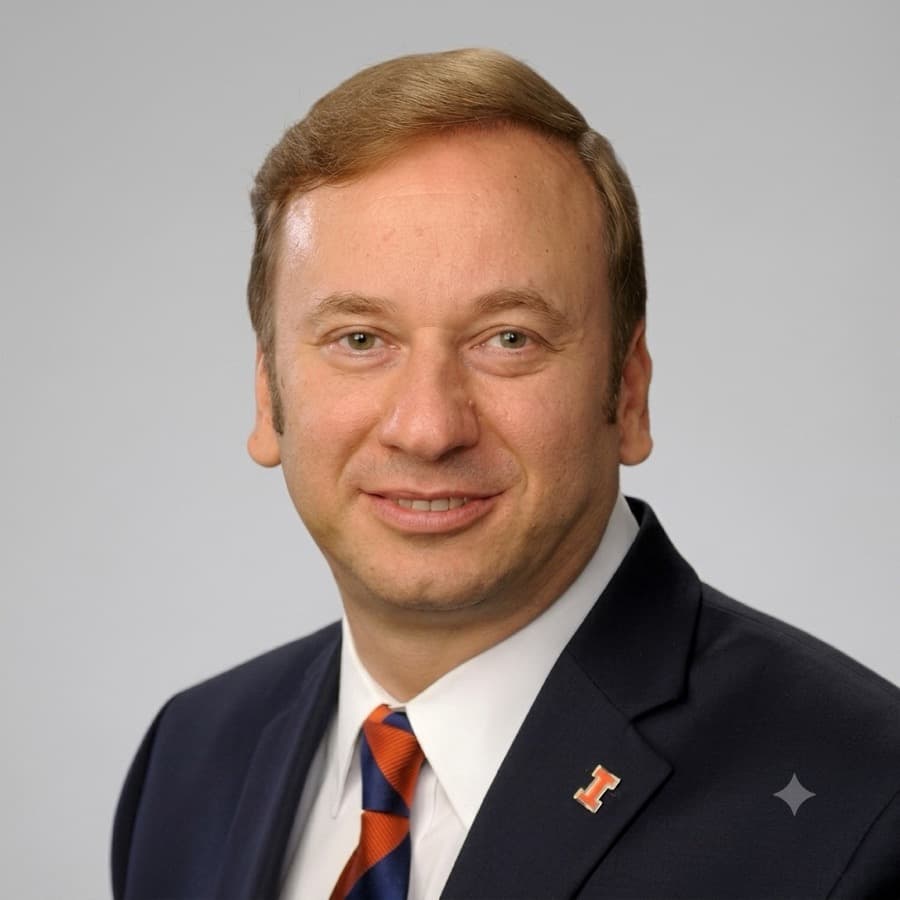
Prof. Erol Tutumluer
埃罗尔·图图姆卢尔教授
美国伊利诺伊大学厄巴纳—香槟分校Abel Bliss讲席教授;国际教育及浙江大学—伊利诺伊大学联合学院教育项目主任
Lecture
有砟轨道变形行为的先进感知与建模
Advanced Sensing and Modeling of Ballasted Track Deformation Behavior
Biography
嘉宾介绍
埃罗尔·图图姆卢尔教授现任美国伊利诺伊大学厄巴纳—香槟分校土木与环境工程系Abel Bliss讲席教授,同时担任Paul F. Kent冠名学者以及国际教育和浙江大学—伊利诺伊大学联合学院教育项目主任。
其研究涵盖道路和铁路路基土及道砟等基础材料、土体与集料稳定、土工合成材料、先进成像、人工智能与深度学习在交通基础设施中的应用、传感器结构健康监测、颗粒基础体系建模、交通基础材料可持续利用、道砟离散元分析、轨道动力响应测量及力学分析设计。
自1996年任教以来,他参与140余项科研项目,指导28名博士和49名硕士毕业,并发表同行评议论文450余篇。他是Elsevier期刊《Transportation Geotechnics》创刊主编,曾任ISSMGE交通岩土工程技术委员会TC202主席,并在美国土木工程师学会、国际土工合成材料学会、美国交通研究委员会和美国铁路工程与养护协会担任多项重要职务。
图图姆卢尔教授曾获TRB Fred Burgraff奖、多项最佳论文奖、中国教育部长江学者奖励计划称号、浙江大学求是特聘教授称号,以及ASCE James Laurie奖、Carl L. Monismith讲座奖、Francis C. Turner奖等荣誉。2025年,他被授予ASCE杰出会员称号,这是该学会授予土木工程师的最高荣誉之一。
Lecture Abstract
报告摘要
中文内容根据会务组提供的英文Biography与Abstract整理。
有砟轨道广泛应用于高速客运与重载货运共线运行的铁路走廊。此类轨道必须具有足够的耐久性和稳定性,并能承受长期重复动荷载而不产生过大变形或显著降低乘坐品质。
研究在实验室建造了一套足尺有砟轨道系统,在由8根轨枕组成的物理试验结构中安装多种传感器,用于研究轨道的详细动力响应和长期行为。试验通过8台作动器依次施加三种速度和轴重组合,模拟慢速重载货运列车及高速客运列车荷载,并测量道砟层和轨枕振动速度、道砟及底砟层底部动土压力、轨枕瞬时与永久竖向变形,以及SmartRock传感器记录的颗粒加速度。
在相同足尺试验条件下,研究还建立了道砟层离散元模型,用于预测实测响应并开展颗粒尺度分析。通过参数标定,使模型能够合理反映室内试验状态,并识别出表面摩擦角、法向接触及剪切接触等参数对预测结果的显著影响。报告将系统比较离散元模型预测结果与室内试验数据,包括轨枕和道砟振动速度、轨枕永久变形、SmartRock加速度及频域轨枕速度。提高轨道基础设施行为预测能力,有助于优化有砟轨道设计与养护计划,并推动高精度数字孪生模型的发展。
Biography — English+
Prof. Erol Tutumluer is Abel Bliss Professor specializing in Transportation Geotechnics in the Department of Civil and Environmental Engineering at the University of Illinois at Urbana-Champaign (UIUC). Professor Tutumluer holds the Paul F. Kent Endowed Faculty Scholar and serves as the Director of International and ZJUI Education Programs. Prof. Tutumluer has research interests and expertise in characterization of pavement and railroad track geomaterials, i.e., subgrade soils and base/ballast unbound aggregates, soil/aggregate stabilization, geosynthetics, advanced imaging techniques and applications of artificial intelligence and deep learning techniques to transportation infrastructure, structural health monitoring of transportation facilities using sensors, modeling granular foundation systems using innovative techniques, sustainable use of foundation geomaterials and construction practices for transportation infrastructure, discrete element analysis of ballast, dynamic response measurement and analyses of track systems, and mechanistic analysis and design.
Since he started as a faculty member at UIUC in 1996, Dr. Tutumluer has served as an investigator on over 140 research projects, graduated 28 PhD and 49 MS students, and authored/co-authored over 450 peer reviewed publications from his research projects. Prof. Tutumluer is a Founding Editor-in-Chief of the Transportation Geotechnics Elsevier journal and the immediate past Chair of the International Society of Soil Mechanics and Geotechnical Engineering Technical Committee 202 on Transportation Geotechnics; he served as TC202 Chair from 2013 until 2022. Prof. Tutumluer is a Distinguished Member of the American Society of Civil Engineers involved with both the Transportation and Development Institute and Geo-Institute and served as Chair of the ASCE Geo-Institute’s Pavements Committee. He is a member of AREMA Committee 1 on Roadway and Ballast. As a Council Member of the International Geosynthetics Society, Dr. Tutumluer currently serves as Chair of the IGS Technical Committee on Roads, Railways and Airfields. Dr. Tutumluer is an Executive Board Member of the Transportation Research Board’s Transportation Infrastructure Group and has held several committee leadership positions.
Prof. Tutumluer has received numerous honors, including the TRB Fred Burgraff Award, several TRB Best Paper Awards, the Yangtze River Scholar Award, the Qiushi Distinguished Professor title at Zhejiang University, the ASCE T&DI James Laurie Prize, the ASCE Geo-Institute Carl L. Monismith Lecture Award, an IGS Award, the ASCE T&DI Francis C. Turner Award, and the 5th Ralph R. Proctor Named Lecture of the ISSMGE. In 2025, he was named Distinguished Member, the highest honor ASCE bestows.
Abstract — English+
Ballasted tracks are commonly used in shared corridors supporting both high speed passenger and freight trains in many countries. Ballasted tracks must be durable, stable, and able to withstand repetitive dynamic loading without excessive deformation or ride quality degradation, all of which need to be carefully studied. A full-scale ballasted track was constructed in the laboratory with a multitude of sensors installed in the 8-crosstie track structure physical experiment with the goal to study the detailed dynamic response and long-term behavior. Three different speed and axle load configurations were applied sequentially onto the full-scale ballasted track using eight actuators, which realistically captured both slow moving heavy freight and high-speed passenger train loads. Vibration velocities of ballast layer and crossties, dynamic soil stresses at the bottom of ballast and subballast layers, crosstie vertical transient and permanent deformations, and an innovative “SmartRock” sensor measured particle accelerations were all captured and analyzed. Following the same full-scale experimental setup, a Discrete Element Method based simulation model of the ballast layer was also created for predicting measured responses and conducting ballast particle level analyses based on the advanced sensor data. Model parameter calibrations were first conducted to have the DEM model realistically representing laboratory situations. Surface friction angle and normal contact/shear contact were found to have significant influence on model predictions. This paper will present the predictions generated by the calibrated DEM model comprehensively compared with laboratory measurements including crosstie and ballast vibration velocity, crosstie permanent deformation, SmartRock acceleration, and crosstie velocity in frequency domain. A better prediction ability of track infrastructure behavior will help improve ballasted track designs and maintenance scheduling and lead to the development of accurate digital twin models.